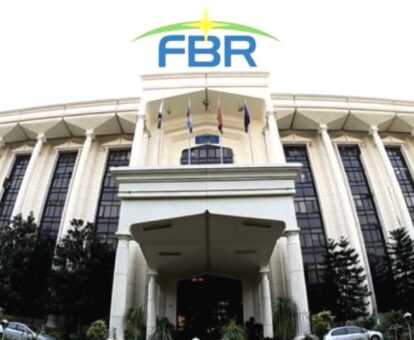
FBR, Pakistan’s national tax collecting agency, plays a crucial role in the country’s economy. Pakistan Revenue is committed to providing readers with the latest updates and developments regarding FBR activities.
195. Prosecution for making false or misleading statements. — (1) A person who –
(a) makes a statement to an income tax authority that is false or misleading in a material particular; or
(b) omits from a statement made to an income tax authority any matter or thing without which the statement is misleading in a material particular,
shall commit an offence punishable on conviction –
(i) where the statement or omission was made knowingly or recklessly, with a fine or imprisonment for a term not exceeding two years, or both; or
(ii) in any other case, with a fine.
(2) A person shall not commit an offence under sub-section (1) if the person did not know and could not reasonably be expected to have known that the statement to which the prosecution relates was false or misleading.
(3) “Entry against S.No 10 in column (2) of the Table in sub-section (1) of section 182” shall apply in determining whether a person has made a statement to an income tax authority.
(Disclaimer: The text of the above section is only for information. Team PkRevenue.com makes all efforts to provide the correct version of the text. However, the team PkRevenue.com is not responsible for any error or omission.)
Section 194 of the Income Tax Ordinance, 2001, updated up to June 30, 2021, now explicitly prescribes prosecution for the improper use of the National Tax Number (NTN) Certificate.
Section 192B of Income Tax Ordinance, 2001, updated up to June 30, 2021, now prescribes severe penalties, including imprisonment for up to three years, for individuals who fail to declare offshore assets or provide inaccurate particulars.
The Federal Board of Revenue (FBR) has categorically refuted recent reports suggesting a possible extension of the deadline for filing income tax returns for the tax year 2021.
ISLAMABAD: Finance Minister Shaukat Tarin on Tuesday presided over a meeting on the establishment of Pakistan International e-payment gateway (IPG).
The IPG will pave the way for financial inclusion and payment digitization which is a sub-component of the 09-pillars of the E-Commerce policy.
Federal Minister for IT & Telecommunication Syed Amin-ul-Haque, Adviser on Commerce Abdul Razak Dawood, CEO NITB Syed Hussain Abbas Kazmi, Secretary Commerce, senior policy analyst and other senior officers participated in the meeting.
A consultative session was held with all relevant stakeholders to identify gaps between payment solutions available domestically and its integration with international payment gateway solution providers to promote e-commerce.
The Adviser on Commerce briefed the participants about the current digital financial landscape in the country.
SBP governor outlined steps being taken for the financial inclusion of domestic banks.
Federal Minister for IT and Telecom assured full facilitation in the provision of enabling environment to the service providers as needed under IPG.
In his remarks, the Finance Minister directed the authorities to follow best international practices and devise a way forward for implementing an international payment gateway ensuring transparency and due consultation with key stakeholders both in public and private sectors.
The Finance Minister constituted a 04-member Committee headed by the Secretary of Commerce and comprising representatives of the Ministry of Commerce, Finance Division and Federal Board of Revenue (FBR).
The Finance Minister further directed to seek input from the President, Pakistan Banking Association (PBA) and leading market players from the private sector to understand their requirements and present a framework for further deliberation after 04 weeks.
In his concluding remarks, the Finance Minister stated that Government will be the facilitator and regulator in a journey towards implementing IPG. The establishment of an international e-payment gateway will improve consumer confidence in E-Commerce through global connectivity
Section 193 of Income Tax Ordinance, 2001, updated up to June 30, 2021, now emphasizes that a taxpayer may face two years imprisonment on failure to keep record.
Income Tax Ordinance, 2001 has specifically outlined two years jail for concealment of income. Section 192A of the Income Tax Ordinance, 2001, as amended through the Finance Act, 2021 and updated until June 30, 2021, outlines serious legal consequences for concealment of income. According to this provision, any individual who deliberately hides their income or provides inaccurate details during tax proceedings can face strict legal action.
It is commendable that the FBR issued the return form for tax year 2021 on July 01, 2021. “It is however, return filers and tax consultants alike are not satisfied with the classification of income set in IRIS, and otherwise are experiencing various computational errors, glitches etc.,” Muhammad Zeeshan Merchant, President, KTBA said in the letter.
The KTBA highlighted following technical issues:
1) COMPUTATION OF CAPITAL GAINS TAX ON DISPOSAL OF IMMOVABLE PROPERTY U/S. 37
The provisions of Section 37(1A) of the Income Tax Ordinance, 2001 (Ordinance) prescribes mode of taxation of gain on disposal of an immovable property on the basis of holding period of the property and the amount of taxable gain; whereas the amount of taxable gain is effectively reduced by 25% with each additional year of holding and finally taxable value is reduced to ‘0’ if the holding period exceeds four years. Correspondingly a variable tax rates are prescribed in Division VIII of Part I of the First Schedule.
Although, law prescribes taxation of gain of immovable property on net amount (refer sub-section (3A) Section 3A) but conversely the return works out the tax liability on gross amount of gain.
2) LOSS ON DISPOSAL OF SECURITIES U/S. 37A
Similarly, in line with Section 37A, unadjusted loss on disposal of securities during the Tax Year 2019 and onwards shall be carried forward to subsequent three tax year or is adjustable only against the gain of the person’s gain on disposal of securities in succeeding three years. Conversely, the web portal does not have any enabling/dedicated field / tab to declare the amount of loss sustained on disposal of securities and carried forward to future tax periods. Moreover, if such a loss on capital gain of securities is reported under the existing tab the same is resulting in a negative amount of tax that ultimately results in incorrect tax computation.
3) INCORRECT WORKING OF TAX DEPRECATION U/S. 22
In order to restrict claim of depreciation upto 50% to first time return filers a proviso to Section 22(2) is inserted via Finance Act 2020 which to the exclusion of Special Tax Year 2021 is expressly applicable w.e.f. July 2020; however, IRIS portal is applying this restriction in cases of Special Tax Year.
4) INITIAL ALLOWANCE ON PLANT & MACHINERY U/S. 23
Subject to certain restrictions initial allowance @ 25% is allowed against plant and machinery on the strength of proviso to Section 23 (read with Part II of the Third Schedule). The IRIS web portal is presently not catering this scenario in line with law resulting in an incorrect computation of tax depreciation.
5) TAX ON FEE FOR TECHNICAL SERVICES / ROYALTY OF A NON-RESIDENT PERSON
Under the provisions of Section 152(1) read with Sections 6 and 8 of the Ordinance, the tax deducted on payment of Pakistan-sourced Royalty and Fee for Technical Services of a non-resident person is a Final Tax. The online return form is presently classifying it under ‘minimum tax tab’ resulting in a incorrect higher tax liability.
6) DISCREPANCIES IN DETAILS AVAILABLE ON FBR ONLINE PLATFORMS
For past few years, the FBR has started sharing information regarding WH/advance taxes through “FBR Maloomat” and recently via “MIS”. It is, however, as of today the information at times is patchy and is not complete and correct either. Given that, it is suggested that unless the scheme is fully operational, tax deduction certificates will continue to be acceptable and no adverse inference should be taken for discrepancies on this score.
7) SIMPLIFIED RETURN FOR SMEs
A simplified scheme for manufacturing SMEs (having turnover upto 250 m) is introduced by adding Section 110E read with Fourteenth Schedule through Finance Act, 2021. It is however, in patent disregard for Section 237, no draft return for this purpose was notified and a return is uploaded on the portal without any notification as well as without following the conditions of Rule 34A putting validity of the return in jeopardy. A few anomalies in this return (though still not notified) are also experienced by us and is shared below for your appreciation:
The return is accepting turnover in excess of Rs. 250(M) in revenue tab which ought to be restricted to Rs. 250(M).
It is not applying correct rate of tax in case a person who opts not to avail FTR and creating incorrect tax liability. Screen shots from return is shared below for your understanding.
It has also been observed that an assignment for re-filing of SME return afresh is available to a person who already had filed its return; without any recourse for a revised return.
Although law requires dedicated registration SME at IRIS portal however, the portal sans this feature as yet; needless to add that selection from “attribute tab” is not an apt option for this purpose.
8) DISCLOSURE OF TAX COLLECTED UNDER SECTION 236D
Through the Finance Act, 2020, the advance tax on function and gatherings has been withdrawn which is practically applicable from July 1, 2020, it is however persons following Special Tax Year are yet to claim this collection/deduction whereas this filed has been removed from the return. It is therefore, suggested that field should be reinstated to claim tax deduction who are entitled for that.
9) WEALTH STATEMENT FOR NON-RESIDENT INDIVIDUALS
It has been observed that statement of wealth for tax year 2021 is pre-populated with opening balance of last year’s closing balance without considering the tax residency of a person.Consequently, non-resident individuals who otherwise is not required to file a wealth statement cannot proceed to file a return of income in the presence of such unnecessary disclosure.
10) DISCREPANCIES IN TAX COMPUTATION OF A COMMERCIAL IMPORTER
Through Finance Act, 2019, the facility of FTR for commercial importers has been abolished. In order to cater the transition period, the FBR has made appropriate changes in the computation of tax liability of commercial importer like impact of closing and opening stocks. However, IRIS web portal is not catering the impact of closing / opening stock which is resulting in an incorrect tax computation.
11) INCOME ATTRIBUTION WITH RESPECT TO MINIMUM TAXATION U/S. 153 AND U/S. 234A
It has been observed that IRIS web portal is presently computing and attributing income of persons associated to Section 153 and Section 234A on certain predefined and programmed formula.
It is suggested that such persons should be allowed to compute and attribute their incomes based on facts instead of predefined or programmed formula and relevant field should be relaxed.
12) COMPUTATION OF FOREIGN INCOMES
Though tabs for various classification of incomes has now been catered in the return of income it has however, been observed that portal is computing tax for all streams of income on the basis of business income.
For the purpose of better appreciation of all issues in correct and true spirit and to create a harmonized approach, we suggest you that a joint meeting (physical or online) between the representatives of KTBA and FBR’s Policy, Legal, IT/PRAL Divisions should be fixed (preferably in current week) at mutual convenience. The KTBA will be glad to assist the FBR’s technical team and join hand for the earliest resolution of the issues.
ISLAMABAD: The Federal Board of Revenue (FBR) has revised taxation for banks from tax year 2022 (starting from January 01, 2021, to December 31, 2021) onwards.
Through Finance Act, 2021, a sub-rule (6A) in rule 6C of Income Tax Ordinance, 2001 was introduced, which was applicable for banks from the tax year 2022 (January 01, 2021 to December 31, 2021).
The text of sub-rule 6A was:
(6A) For tax year 2022 onwards, the taxable income attributable to investment in the Federal Government securities shall be taxed at the rate of—
(i) 40 per cent instead of rate provided in Division II of Part I of the First schedule if the assets to deposit ratio as on last day of the tax year is upto 40 per cent;
(ii) 37.5 per cent instead of rate provided in Division II of Part I of the First schedule if the assets to deposit ratio as on last day of the tax year exceeds 40 per cent but does not exceed 50 per cent; and
(iii) at the rates provided in Division II of Part I of the First schedule if assets to deposit ratio as on last day of the tax year exceeds 50 per cent.
However, through Tax Laws (Third Amendment) Ordinance, 2021 this was amended and for the words ‘assets’, wherever occurring, the words ‘gross advances’ shall be substituted.
Tax experts believe that the amendment would have a negative impact on banks with ADR of less than 50 per cent as they have to pay additional tax on their entire income arising from investment in government securities rather than additional income as was the case previously.
They said that the banks with low ADR took the impact of the same in June 2021 financial results and as a result effective tax rate of banking sector increased from 38 per cent in 2Q2020 to 40 per cent in 2Q2021. This is likely to have an earnings impact of around 5-10 per cent for the sector.
The idea of this increased taxation was to encourage banks to increase their lending activity but this remains a big question mark of how effective this policy measure will be.
The latest banking sector data (week ending September 3, 2021) show that ADR of the sector is at 47 per cent, below the threshold of 50 per cent for additional taxation. This compares to ADR of 48 per cent in Sep-2020 and 45 per cent in Jun-2021.
Section 192 of the Income Tax Ordinance, 2001, as updated up to June 30, 2021, through the Finance Act, 2021, recommends a three-year jail term for individuals found guilty of making false statements before the Commissioner Inland Revenue (IR).