Islamabad, June 26, 2024 – In a significant policy shift, Finance Minister Muhammad Aurangzeb announced on Tuesday that heavy taxes on retailers will take effect from July 1, 2024.
(more…)Tag: National Assembly of Pakistan
-
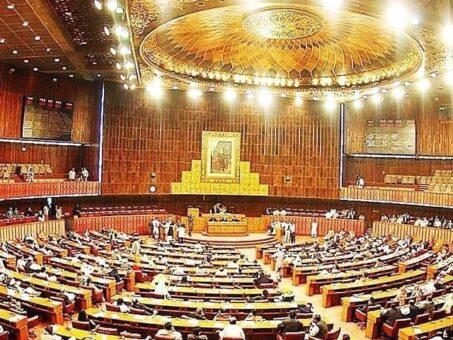
National Assembly Sets Budget 2024-25 Session for June 6th
As Pakistan’s National Assembly continues its proceedings, plans for the upcoming budget session for the fiscal year 2024-25 are taking shape, with discussions slated to begin on June 6th, 2024.
(more…) -
National Assembly Passes Money Bill to Amend Tax Laws
Islamabad, April 29, 2024 – The National Assembly of Pakistan took a significant step forward in tax reform by approving a new money bill aimed at amending existing tax laws, which promises to streamline the tax litigation process and strengthen tax compliance across the country.
(more…) -
National Assembly Approves Budget 2023-24 with New Recommendations of Heavy Taxes
Islamabad, June 25, 2023: The National Assembly of Pakistan has given its approval to the budget for 2023-24, incorporating new recommendations for imposing significant taxes.
(more…) -
National Assembly rejects bill seeking funds for Punjab and KPK elections
The National Assembly of Pakistan Thursday rejected a bill that sought funding for provincial elections in Punjab and Khyber Pakhtunkhwa.
(more…) -
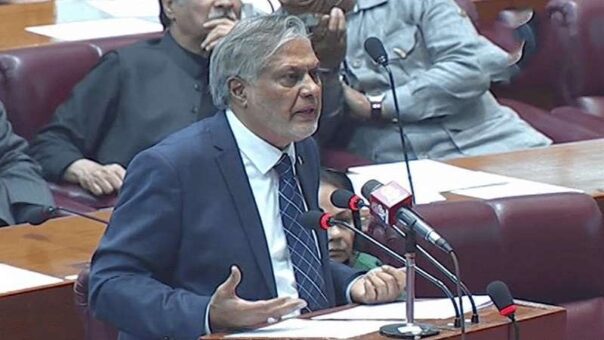
Ishaq Dar presents money bill to fund provincial elections
On Monday, Finance Minister Ishaq Dar introduced a money bill to provide funds for provincial elections.
(more…) -
National Assembly passes resolution against Supreme Court’s election decision
ISLAMABAD: On Thursday, a resolution was passed by the National Assembly rejecting the decision made by a three-member bench of the Supreme Court regarding the delay of Punjab elections.
(more…) -
Risks to reforms as national assembly dissolved
Pakistan’s political saga took a surprising turn over the weekend as Pakistan’s President approved the dissolution of the National Assembly on the Prime Minister’s advice, analysts at KASB Research said.
Imran Khan then announced early elections, likely within the next 3 to 6 months. Most notably, the Supreme Court of Pakistan (SCP) has scheduled a hearing on the Suo Moto notice taken by the CJP over the incident. Any parliamentary actions thereafter will be subject to the court’s orders.
A credit-negative event for Pakistan’s economy:
READ MORE: Pakistan’s headline inflation increases by 12.7% in March
The decision to dissolve the national assembly is likely a credit-negative event for the economy. Considerable risks to announced reforms have arisen, including fiscal reforms and planned revitalization of the energy sector. Moreover, concerns of delays in the upcoming federal budget will drive sentiments of further delays in the IMF tranche’s approval. With SBP’s reserves falling to a 15 months low level of 12.1 billion (import cover: nine weeks), risks to Pakistan’s credit outlook have greatly heightened.
The scenario is evidenced by the rising international bond yields of Pakistan securities, whose yields have surged past 16 per cent compared to 5 per cent a few months prior. Moreover, Pakistan’s CDS spreads have also crossed the 10 per cent mark, a rise of 6pps from a month prior. Month to date, foreign investors have offloaded USD 28 million worth of equities, and we expect potential outflows to gain pace in the coming weeks as the political situation unfolds.
READ MORE: Pakistan’s weekly forex reserves deplete by $2.88 billion
Secondary market yields and currency likely to rise further:
We expect secondary market yields of domestic securities to face additional upside pressure as macroeconomic risks heighten. Yields were already on a sharp upwards trajectory following the rise in global commodity prices, rising risks to external accounts, and falling foreign currency reserves. Rising domestic yields will likely translate to increased lending rates. Moreover, external account imbalances amidst the commodity upcycle, coupled with expected delays in the IMF tranche, will likely keep the Pak Rupee under pressure.
Sectors dependent on policy reforms will likely underperform:
We highlight risks to sectors whose performance outlook hinged on the planned policy reforms. These risks are particularly weighted towards Pakistan’s energy sector, which is presently plagued with considerable inefficiencies. We had earlier highlighted our preference for the sector on account of the planned reforms to uplift the industry, including significant actions to curb the circular debt growth.
Key risks to the energy sector emerging:
1) Oil and Gas Exploration: The WACOG bill was introduced to alleviate the cash flow crunch of the sector originating from the sale of gas. With expected delays in the implementation of the WACOG bill, which has faced harsh criticism from the opposition, we expect the cash flow woes of the sector to continue for a sustained period.
READ MORE: Ukraine crisis, political unrest major threats to economy
2) Oil and Gas Marketing: The WACOG bill was also expected to alleviate the cash flow issues of the OMC sector, particularly PSO. Moreover, planned reforms to ease the circular debt, including a distribution network uplift, may also face delays, further exacerbating the industry’s cash flows.
3) Independent Power Producers: The IPPs were also expected to benefit from actions to curb the circular debt. Most notably, the sector’s collections have considerably worsened after the recent surge in global energy prices. While the government had plans to set up a Revolving Account of PKR 50bn to ensure timely clearance of overdue bills, any delays on this front will continue to keep the sector’s cash flows under pressure.
READ MORE: IMF to agree on Pakistan’s industrial promotion package
4) Refineries: The improving outlook on refineries was largely dependent on the approval of a long-term refinery policy, which was expected to attract investments of up to USD 10.0bn. We project significant delays in the policy’s approval and expect the sector to continue underperforming over the medium term.
Macroeconomic hedged sectors to fare better:
As highlighted in one of our previous reports (Pakistan Strategy – USD hedged stocks a shield against macroeconomic heads), we prefer industries capable of weathering the macroeconomic headwinds including Textiles and Technology. These industries have a relative shield against rising interest rates and currency weakness.
-
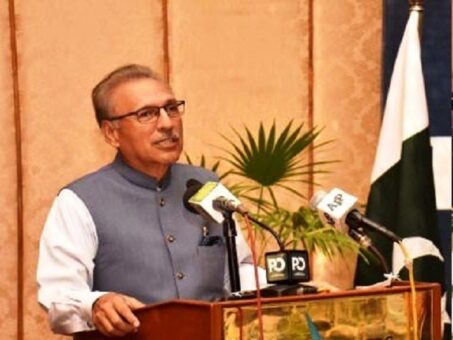
President gives assent to bills passed by Parliament
ISLAMABAD: The President of Pakistan, Dr. Arif Alvi has accorded assent to the bills that were passed by the National Assembly – Parliament on November 17, 2021, a statement said on Wednesday.
On the summaries initiated by National Assembly Secretariat and on the advice of the Prime Minister, the President of Pakistan has accorded his assent to the following Bills, in terms of Article 75 of the Constitution of the Islamic Republic of Pakistan, 1973:-
(i) The Privatization Commission (Amendment) Bill, 2021
(ii) The Port Qasim Authority (Amendment) Bill, 2021
(iii) The Islamabad Capital Territory Prohibition of Corporal Punishment Bill, 2021
(iv) The International Court of Justice (Review and Re-Consideration) Bill, 2021
(v) The SBP Banking Services Corporation (Amendment) Bill, 2021
(vi) The Corporate Restructuring Companies (Amendment) Bill, 2021
(vii) COVID-19 (Prevention of Hoarding) Bill, 2021
(viii) The Anti-Rape (Investigation and Trial) Bill, 2021
(ix) The Islamabad Capital Territory Charities Registration, Regulation and Facilitation Bill, 2021
(x) The Islamabad Rent Restriction (Amendment) Bill, 2021
(xi) The Prevention of Corruption (Amendment) Bill, 2021
(xii) The Federal Public Service Commission (Validation of Rules), Bill, 2021
(xiii) The Loans for Agricultural, Commercial and Industrial Purposes Amendment) Bill, 2021
(xiv) The National Vocational and Technical Training Commission (Amendment) Bill, 2021
(xv) The Islamabad Capital Territory Food Safety Bill, 2021
(xvi) The Emigration (Amendment) Bill, 2021
(xvii) The Pakistan Academy of Letters (Amendment) Bill, 2021
(xviii) The Gwadar Port Authority (Amendment) Bill, 2021
(xix) The Companies (Amendment) Bill, 2021
(xx) The Maritime Security Agency (Amendment) Bill, 2021
(xxi) The Pakistan National Shipping Corporation (Amendment) Bill, 2021
(xxii) The Financial Institutions (Secured Transactions) (Amendment) Bill, 2021
(xxiii) The University of Islamabad Bill, 2021
(xxiv) The Al-Karam International Institute Bill, 2021
(xxv) The National College of Arts Institute Bill, 2021
(xxvi) The Hyderabad Institute for Technology and Management Sciences Bill, 2021
(xxvii) Regulation of Generation, Transmission and Distribution of Electric Power (Amendment) Bill, 2021
(xxviii) The Provincial Motor Vehicles (Amendment) Bill, 2021
(xxix) The Unani, Ayurvedic and Homeopathic Practitioners (Amendment) Bill, 2021
(xxx) The Muslim Family Laws (Amendment) Bill, 2021
(xxxi) The Muslim Family Laws (Second Amendment) Bill, 2021
The above Bills have been passed by the Majlis-e-Shoora (Parliament) under clause (3) of Article 70 of the Constitution in joint sitting held on November 17, 2021.
-
National Assembly approves budget, finance bill 2021
ISLAMABAD: The National Assembly on Tuesday approved federal budget 2021-2022 and Finance Bill 2021.
After over a two-week long debate, the National Assembly on Tuesday passed the federal budget with a total outlay of Rs 8.487 trillion, with around 19 percent additional allocations as compared to last year’s Rs 7.137 trillion.
The Finance Bill 2021-22 was moved before the parliament by Finance Minister, Shaukat Tarin, which was passed with majority vote.
Some amendments in the bill proposed by the Members of National Assembly were accommodated by the house, whereas some others were rejected.