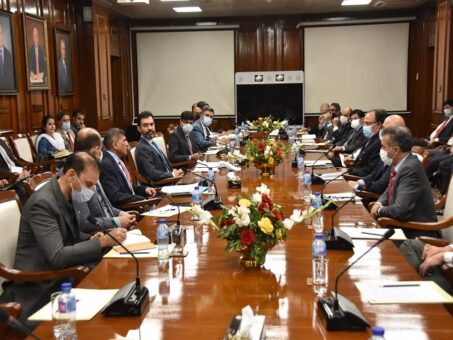
Governor State Bank of Pakistan, Dr. Reza Baqir, chaired a meeting today with Director General FIA Sanaullah Abbasi to strengthen and coordinate efforts of SBP, banks and Federal Investigation Agency (FIA) to fight money laundering, cyber-attacks and online frauds. The meeting was also attended by the Presidents of Banks and senior officers of FIA and SBP.
Governor SBP emphasized the need for close cooperation amongst banks, SBP, and FIA so those white-collar crimes are expeditiously investigated and fraudsters are apprehended and prosecuted.
SBP has taken several measures in the recent past to strengthen its work on Anti-money Laundering (AML) as well as taken regulatory and supervisory measures to improve banks’ controls to prevent digital and social engineering frauds.
In addition to better controls at the level of Financial Institutions and enhanced customers awareness, effective investigation and prosecution of criminals is needed to substantially reduce incidences of money laundering, digital frauds and cyber-attacks.
FIA team offered support in strengthening cyber security at banks and suggested banks carry out an Information Security (IS) audit of their systems. Welcoming the suggestion SBP informed that as per existing regulations banks are required to regularly carry out their information system audit and penetration testing, however, it would be reemphasized to the industry through PBA.
The meeting identified key follow-up areas and associated timelines for strengthening cooperation between SBP, FIA, and banks in these areas.
KARACHI: The State Bank of Pakistan (SBP) on Friday announced overnight repo and overnight reverse repo rates following an increase in the key policy rate to 8.75 per cent.
The SBP said that it decided to increase the ‘Policy Rate’ (Target Rate) from 7.25 per cent to 8.75 per cent.
SBP Overnight Reverse Repo (Ceiling) rate will be at 9.75 per cent i.e. 100 basis points above the SBP Policy Rate.
The SBP Overnight Repo (Floor) rate will be at 7.75 per cent i.e. 100 basis points below the SBP Policy Rate.
Accordingly, the Floor and Ceiling levels for the Interest Rate Corridor are 7.75 per cent and 9.75 per cent per annum respectively (i.e. the width of 200 basis points).
The SBP said that it will continue to ensure that the money market overnight rate remains close to the SBP Policy Rate (Target Rate).
The changes are effective from November 22, 2021. Other instructions on the subject shall, however, remain unchanged, the SBP added.
In continuation of efforts to make the process of monetary policy formulation more predictable and transparent in line with international best practices, the SBP decided to increase the frequency of monetary policy reviews from six (6) to eight (8) times a year.
This action will bring the frequency of meetings in line with that incomparable emerging markets. It will also help to enhance the predictability of monetary policy actions, the SBP added.
Accordingly, the schedule for the next five MPC meetings is as follows:
1. December MPC meeting: Tuesday, 14th Dec 2021
2. January MPC meeting: Monday, 24th Jan 2022
3. March MPC meeting: Tuesday, 8th Mar 2022
4. April MPC meeting: Tuesday, 19th Apr 2022
5. June MPC meeting: Friday, 10th Jun 2022
The advance calendar for the next half-year of MPC meetings will be shared at the time of the June 2022 MPC meeting, the SBP added.
KARACHI: The current account deficit of the country has widened to $5.08 billion during July – October of fiscal year 2021/2022.
According to the balance of payment released by the State Bank of Pakistan (SBP) on Friday the current account deficit during first four months of the current fiscal year widened to $5.08 billion as compared with a surplus of $1.31 billion in the same months of the last year.
During the first four months of the current fiscal year the import bill surged by 64 per cent to $25.1 billion as compared with $15.17 billion in the same months of the last fiscal year.
The exports of the country registered an increase of 25 per cent to $9.46 billion during first four months of the current fiscal year as compared with $7.57 billion in the corresponding months of the last fiscal year.
However, trade deficit widened by 106 per cent to $15.64 billion during first four months of the current fiscal year as compared with the deficit of $7.6 billion in the corresponding months of the last year.
Meanwhile, the inflows of remittances grew by 12 per cent during the first four months of the current fiscal year over the same period last year.
Workers’ remittances increased to $10.55 billion during July – October of the current fiscal year as compared with $9.23 billion in the same period of the last year.
The current account deficit in October 2021 has been recorded at $1.66 billion as compared with the deficit of $1.13 billion in September 2021.
KARACHI: The State Bank of Pakistan (SBP) on Friday decided to increase the key policy rate by 150 basis points to 8.75 per cent for next two months from the existing 7.25 per cent.
At today’s meeting, the Monetary Policy Committee (MPC) decided to raise the policy rate by 150 basis points to 8.75 percent. This reflected the MPC’s view that since the last meeting, risks related to inflation and the balance of payments have increased while the outlook for growth has continued to improve, the SBP said.
The heightened risks related to inflation and balance of payments stem from both global and domestic factors. Across the world, price pressures from Covid-induced disruptions to supply chains and higher energy prices are proving to be larger and longer-lasting than previously anticipated.
In response, central banks have generally begun to tighten monetary policy to keep inflation expectations anchored. In Pakistan too, high import prices have contributed to higher-than-expected CPI, SPI, and core inflation outturns.
At the same time, there are also emerging signs of demand-side pressures on inflation, and inflation expectations of businesses have risen on account of further upside risks from domestic administered prices.
With respect to the balance of payments, the current account deficits in September and October have been larger than anticipated, reflecting both rising oil and commodity prices and buoyant domestic demand. The burden of adjusting to these external pressures has largely fallen on the rupee.
As a result of these developments, the balance of risks has shifted away from growth and toward inflation and the current account faster than expected. Accordingly, the MPC was of the view that there is now a need to proceed faster to normalize monetary policy to counter inflationary pressures and preserve stability with growth.
Today’s rate increase is a material move in this direction. Looking ahead, the MPC reiterated that the end goal of mildly positive real interest rates remains unchanged and, given today’s move, expects to take measured steps to that end.
In reaching its decision, the MPC considered key trends and prospects in the real, external and fiscal sectors, and the resulting outlook for monetary conditions and inflation.
The economic recovery underway since the start of FY21 continues, as reflected in most high-frequency indicators of domestic demand―including automobile sales, POL (petroleum, oil and lubricants) sales, and electricity generation―as well as the strength of imports and tax revenues.
Notwithstanding some moderation in September due to a high base effect and some supply chain disruptions, LSM registered broad-based growth of 5.2 percent (y/y) in Q1-FY22, led by production of consumer goods (both durable and non-durable), construction-allied, and export industries.
In agriculture, production levels of all major Kharif crops except cotton are estimated to have reached all-time highs. Cotton production has also rebounded, with arrivals at ginneries growing by 80 percent as of 1st November compared to the same period last season. Overall, the economic recovery appears increasingly durable and self-sustaining, against the backdrop of rapidly falling Covid cases and the government’s vigorous vaccination roll-out.
Looking ahead, rising input costs and normalization of macroeconomic policies are likely to lead to some moderation in the growth of industrial activity. Nevertheless, this could be more than offset by the improved outlook for agriculture, such that risks to the growth forecast of 4-5 percent in FY22 are tilted to the upside.
Persistently high international commodity prices and strong domestic activity kept the current account deficit elevated at $3.4 billion in Q1-FY22.
The deficit widened to$1.66 billion in October from $1.13 billion in September due to high energy prices and an uptick in services imports, despite some moderation in non-energy imports. There was also a moderate month-on-month decline in exports and remittances.
The current account deficit for FY22 is expected to modestly exceed the previous forecast of 2-3 percent of GDP.
While the market-based exchange rate has played its due role as a shock absorber, it has borne a considerable burden in terms of adjusting to the widening current account deficit. The rupee has depreciated by a further 3.4 percent since the last MPC meeting. The US dollar also appreciated against most emerging market currencies since May as expectations of tapering by the Federal Reserve have been brought forward. However, the fall in the value of the rupee since May has been comparatively large. As other adjustment tools normalize, including interest rates and fiscal policy, pressures on the rupee should abate.
The overall fiscal deficit improved to 0.8 percent of GDP in Q1-FY22 from 1 percent in the same period last year. This was driven by the above-target growth in FBR tax revenues (38.3 percent (y/y)) despite higher refunds and a significant reduction in the sales tax rate on POL. However, non-tax revenue fell by 22.6 percent (y/y) due to a sharp decline in petroleum development levy (PDL) collection. In addition, the primary surplus was 28.6 percent lower than in Q1-FY21, due to a 33 percent (y/y) growth in non-interest spending. Looking ahead, it will be important to achieve the fiscal consolidation plan in the budget to help restrain domestic demand. A higher-than-planned primary fiscal deficit would likely worsen the outlook for inflation and the current account and would undermine the durability of the recovery.
Real money supply growth has accelerated in recent months to above-trend levels. With the economic recovery on a sound footing, there is a need to pare back this growth as part of the broader move toward normalizing monetary conditions. The MPC noted that the recent increase in banks’ cash reserve requirements would help in this regard.
Inflationary pressures have increased considerably since the last MPC meeting, with headline inflation rising from 8.4 percent (y/y) in August to 9 percent in September and further to 9.2 percent in October, mainly driven by higher energy costs and a rise in core inflation.
The momentum of inflation has also picked up significantly, with average m/m inflation in the last two months at an elevated 2 percent and all sub-components of the CPI basket showing an acceleration. Core inflation has also picked up in the last two months, rising to 6.7 percent (y/y) in both urban and rural areas on the back of house rents, cloth and garments, medicines, footwear, and other components.
In addition, inflation expectations of households remain elevated and those of businesses have risen sharply. Looking ahead, global commodity prices and potential further upward adjustments in administered prices of energy pose upside risks to the average inflation forecast of 7-9 percent in FY22.
The MPC will continue to carefully monitor developments affecting medium-term prospects for inflation, financial stability and growth and stands ready to respond appropriately.
The SBP said the data is compiled and disseminated for information only. These exchange rates are estimates that quoted by various commercial banks to their clients.
KARACHI: The dollar is again reached above Rs175 near an all-time high despite efforts made by the central bank to stabilize the local currency, dealers said on Friday.
The State Bank of Pakistan (SBP) last week announced to increase the average Cash Reserve Requirement (CRR), to be maintained during a period of two weeks by scheduled banks, from 5 percent to 6 percent and minimum CRR to be maintained each day from 3 percent to 4 percent.
The rupee made recovery for continuous three sessions following this announcement. The announcement was made on November 12, 2021 when the rupee hit the all-time low of Rs175.73 to the dollar.
However, the local unit lost Rs1.5 against the dollar during the past two sessions on a statement of the finance advisor that he could not give a certain date for inflows from the IMF.
KARACHI: The liquid foreign exchange reserves of the country slipped by $476 million to $23.55 billion by the week ended November 12, 2021, the State Bank of Pakistan (SBP) said on Thursday.
The foreign exchange reserves of the country were at $24.026 billion by the week ended November 05, 2021.
The official reserves of the SBP also fell by $381 million to $16.945 billion by the week ended November 12, 2021, as compared with $17.326 billion a week ago.
The foreign exchange reserves maintained by commercial banks also declined by $95 million to $6.605 billion by the week ended November 12, 2021, as compared with $6.7 billion a week ago.