Month: April 2020

  • Duty free import increases by 17pc despite phasing out exemptions

    Duty free import increases by 17pc despite phasing out exemptions

    KARACHI: Despite elimination of exemption and strengthening enforcement the duty free import surged by 17.1 percent during 2018/2019, according to official documents.

    The FBR in its report released this month said that the duty free imports increased by 17.1 percent to Rs2,445 billion during fiscal year 2018/2019 as compared with Rs2,087 billion in the preceding fiscal year.

    The documents revealed that goods under Chapter 27 of Customs Tariff were imported duty free worth Rs600 billion during fiscal year 2018/2019 as compared with Rs491 billion in the corresponding period of the preceding fiscal year.

    The import of products including Mineral fuels, mineral oils and products under this chapter has increased by 22.3 percent during the period under review.

    An amount of Rs317 billion has been allowed duty free for the import of boilers, machinery and mechanical during fiscal year 2018/2019, which is 12.5 percent higher than Rs282 billion in the same period of the preceding fiscal year.

    The customs authorities granted duty free import of around Rs189 billion for the clearance of organic chemical during fiscal year 2018/2019 as compared with Rs144.85 billion in the preceding fiscal year, showing growth of 30.5 percent.

    Despite lowering of tariff over the years, the customs duty is still one of the important sources of Federal Tax collection. The Dutiable Imports are the tax base for Customs Duty.

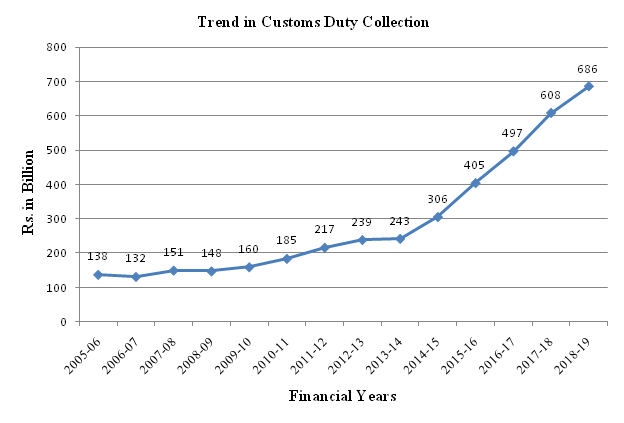
    The collection of customs duty stood at around Rs686 billion and has contributed around 28.8 percent in the Indirect Taxes and 17.9 percent in total taxes during the F.Y.: 2018-2019.

    It has increased by around 13 percent as compared to previous year.

    The target of customs duty was Rs. 735 billion during FY: 2018-2019 which was missed by 6.7 percent.
    Source: FBR

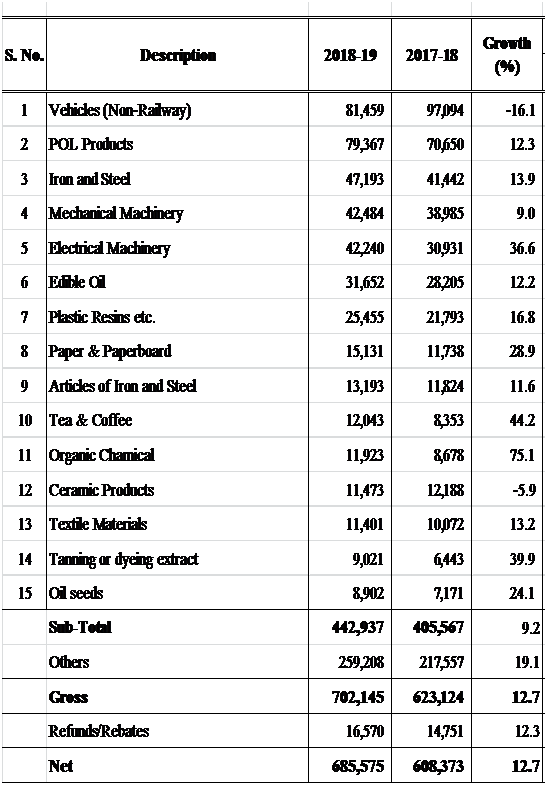
    Out of 15 major revenue spinners, 13 items of imports recorded positive growth during FY: 2018-19 mainly due to increased Imports. On the other hand, only automobile (Ch:87) and ceramic products recorded negative growths.

    The details of Customs Duty collection from major commodity groups (chapters) are presented in table below.
    Source: FBR
  • Tax collection from cash withdrawal falls by 52 percent

    Tax collection from cash withdrawal falls by 52 percent

    ISLAMABAD: The collection of withholding income tax from cash withdrawal from banks fell by 52 percent during first half of the current fiscal year as the government withdrew the levy on active taxpayers.

    The collection of withholding income tax fell to Rs8.6 billion during July – December of current fiscal year 2019/2020 as compared with Rs17.8 billion collected in the corresponding period of the last fiscal year, according to official data.

    Through Finance Act, 2019, the imposition of withholding tax on cash withdrawal by active taxpayers was eliminated in order to encourage income tax return filing.

    However, the withholding tax rate at the rate of 0.6 percent is still leviable on persons not appearing on the active taxpayers list issued by the Federal Board of Revenue (FBR).

    At present every banking company is required under Section 231A of Income Tax Ordinance, 2001 to collect withholding tax at 0.6 percent on payment for cash withdrawal, or sum total of payment for cash withdrawal, in a day, exceeding Rs50,000 for persons not appearing the Active Taxpayers List (ATL).

    The same rate of 0.6 percent is applicable under Section 231AA and Section 231AA of the Ordinance on sale against cash of any instrument including demand draft, payment order, CDR, STDR, RTC, any other instrument of bearer nature or on receipt of cash on cancellation of any of these instruments where sum total of transactions exceeds Rs, 25,000 in a day, for persons not appearing in the Active Taxpayers’ List and transfer of any sum against cash through online transfer, telegraphic transfer mail transfer or any other mode of electronic transfer, where sum total of transactions exceed Rs. 25,000/-in a day, for persons not appearing in the Active Payers’ List.

  • So far 80,368 borrowers avail loan rescheduling facility

    So far 80,368 borrowers avail loan rescheduling facility

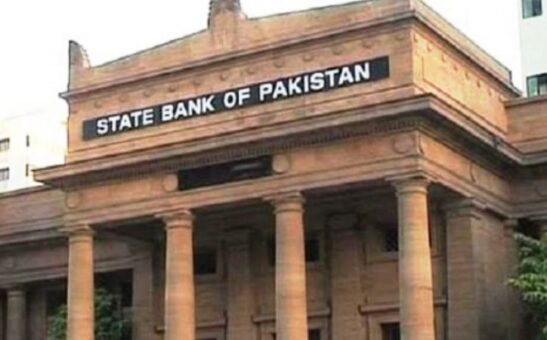
    KARACHI: State Bank of Pakistan (SBP) on Wednesday said that around 80,368 borrowers availed deferment of principal repayment facility, which was granted considering outbreak of coronavirus.

    The SBP said that under the relief package up till April 10, 2020 around 80368 borrowers benefitted from deferment of principal repayment worth Rs20 billion.

    Additional Rs 1.4 billion has been restructured. Meanwhile, 5126 application were under process, the SBP said.

    Previously, the SBP through a circular noted that banks and DFIs will defer the payment of principal on loans and advances by one year.

    To avail this relaxation, borrowers should submit a written request to the banks before June 30, 2020.

    They will, however, continue to service the mark-up amount as per agreed terms and conditions.

    The deferment of principal will not affect borrower’s credit history and such facilities will also not be reported as restructured/rescheduled in the credit bureau’s data.

    The total amount of principal coming due over the next year is about Rs. 4,700 billion.

  • Equity market sheds 19 points in mixed trading

    Equity market sheds 19 points in mixed trading

    KARACHI: The equity market fell by 19 points on Wednesday in mixed trading sessions during the day.

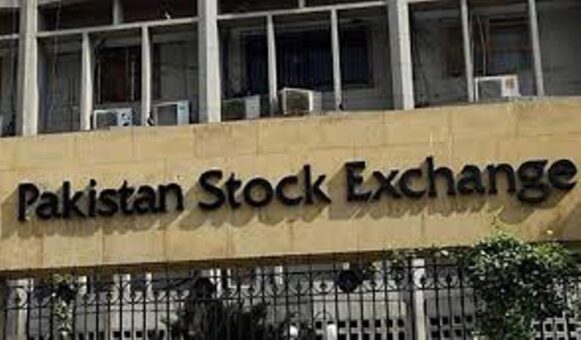
    The benchmark KSE-100 index of Pakistan Stock Exchange (PSX) closed at 31,242 points as against 31,223 points showing an increase of 19 points.

    Analysts at Arif Habib Limited said that the market opened on a positive note today with 165 points, which was primarily the reaction to partial opening of various industries and sectors decided by the federal and provincial governments.

    The index surged by 572 points, barring E&P and O&GMCs, during the session despite downward trend in international crude prices.

    As WTI dropped by more than 4.5 percent to touch 18-year low (2002) of US$ 19.20/bbl, E&P and O&GMCs lost support from levels maintained in trades earlier in the session.

    Cement Sector, which was the highlight of today and performed well during the session also saw profit booking by the end of session. Strong price performance was contributed by Fertilizer Sector.

    Early on, the support for benchmark KSE-100 index came from index heavy weights, ENGRO, HUBC, LUCK, DAWH and FFC.

    Secondary market PIB yields also dropped further to indicate optimism for a rate cut in the upcoming monetary policy. 10yr PIB was observed trading at 8.65 percent.

    Cement sector continued leading the volumes with 61.9 million shares, followed by O&GMCs (15.6 million) and Chemical (14.2 million). Among scrips, MLCF realized 22.5 million shares, followed by HASCOL (10.9 million) and FCCL (9.5 million).

    Sectors contributing to the performance include E&P (-107 points), Banks (-36 points), Food (-21 points), Inv Banks (+60 points), Cement (+41 points), Fertilizer (+26 points) and Pharma (+23 points).

    Volumes increased from 130.4 million shares to 1856 million shares (+42 percent DoD) Average traded value also increased by 55 percent to reach US$ 44.8 million as against US$ 28.8 million.

    Stocks that contributed significantly to the volumes include MLCF, HASCOL, FCCL, PIOC and DGKC, which formed 32 percent of total volumes.

    Stocks that contributed positively to the index include DAWH (+59 points), LUCK (18 points), FFC (+14 points), ABOT (+12 points) and EPCL (+11 points). Stocks that contributed negatively include OGDC (-37 points), PPL (-35 points), POL (-29 points), NESTLE (-25 points), and BAFL (-16 points).

  • Rupee extends losses on import payment

    Rupee extends losses on import payment

    KARACHI: The Pak Rupee extended losses against dollar on Wednesday owing to persistent demand for import payment, dealers said.

    The rupee ended at Rs166.98 to the dollar from previous day’s closing of Rs166.95 in interbank foreign exchange market.

    The currency dealers said that the rupee was remained under pressure due to higher demand of the foreign currency for commodity payment, mainly related to holy month of Ramazan.

    Currency experts said that the rupee may make gain in coming days with expected disbursement by the IMF.

    They said that the IMF disbursement would help the country to improve foreign exchange reserves.

    The experts said that the rupee likely to gain further in future owing to lower import payment demand after decline in international oil prices.

    The import bill of the country has declined by 21 percent in March 2020 over the previous month owing to lockdown to contain coronavirus pandemic.

    The import bill was at $3.3 billion in March 2020 as compared with $4.185 billion in February 2020, according to data released by Pakistan Bureau of Statistics (PBS) on Friday.

    Similarly, the pandemic also adversely affected the country’s exports. The exports fell by 15.56 percent to $1.8 billion in March 2020 as compared with $2.14 billion in February 2020.

    The total import bill during July – March 2019/2020 fell by 14.42 percent to $38.81 billion as compared with $40.68 billion in the corresponding period of the last fiscal year.

    However, the exports registered increase of 2.23 percent during first nine months of current fiscal year to $17.45 billion as compared with $17 billion in the corresponding months of the last fiscal year.

    The trade deficit during first nine months contracted by 26.45 percent to $17.36 billion as compared with the deficit of $23.61 billion in the corresponding period of the last fiscal year.

  • SBP expands incentive scheme for home remittance promotion

    SBP expands incentive scheme for home remittance promotion

    KARACHI: State Bank of Pakistan (SBP) on Wednesday expanded incentive scheme for exchange companies for promoting home remittances through formal channels.

    The SBP previously on December 06, 2019 introduced the incentive scheme on which exchange companies were allowed market expenses reimbursement of Re. 1 per each incremental US dollar mobilized over 15 percent growth.

    The SBP in this regard decided that with immediate effect the existing incentive scheme for marketing of home remittances i.e. Re 1 against US Dollar 01 of remittance amount beyond 15 percent growth over last year may now be based on tiered growth i.e. Rs. 0.50 on 5 percent growth, Rs. 0.75 on 10 percent growth and Rs. 1.00 on 15 percent growth.

    Through another circular issued to authorized dealers in foreign exchange and microfinance banks, the SBP said that it has been decided with immediate effect that the prevailing rate of TT charges may be enhanced from SAR 10/- to SAR 20/- for transactions between USD 100-200.

    The SBP further said that the existing Incentive scheme for marketing of home remittances i.e. PKR 01 against USD 01 of remittance amount beyond 15 percent growth over last year may now be based on tiered growth i.e. Rs. 0.50 on 5 percent growth, Rs. 0.75 on 10 percent growth and Rs. 1.00 on 15 percent growth.

  • Tax collection from salary income surges by 75 percent

    Tax collection from salary income surges by 75 percent

    ISLAMABAD: Tax collection from salary increase has sharply increased by 75 percent during first half (July – December) of current fiscal year 2019/2020 owing to changes brought in tax rates through Finance Act, 2019.

    According to official data, the Federal Board of Revenue (FBR) collected Rs57.5 billion from salary income during July – December 2019/2020 as compared with Rs32.8 billion in the corresponding period of the last fiscal year.

    It is pertinent to mention here that the threshold income has been enhanced to Rs600,000 for calculation of income tax for tax year 2020 as compared with Rs400,000 prevailed during tax year 2019.

    The FBR issued withholding tax card for tax year 2019/2020 effective from July 01, 2019 under which every employer paying salary to employees above threshold income shall deduct withholding tax.

    The FBR said that every person responsible for paying salary to an employee shall deduct tax from the amount paid under Section 149 of Income Tax Ordinance, 2001.

    As per Finance Act, 2019, the provisions of newly inserted 10th schedule of the Income Tax Ordinance, 2001 shall not apply on tax deducted under section 149. Under the Tenth Schedule the withholding tax so collected shall be increased by 100 percent in case of persons not appearing on the Active Taxpayers List (ATL).

    As per Finance Act, 2019, the salary slabs as well as tax rates have been revised with effect from 01.07.2019. As such all withholding tax agents disbursing salary are required to implement the revised tax rates from the same date.

    Following are the salary slabs and rates on annual salary income:

    TABLE

    Salary SlabsTax Rates on salary slabs
    1. Where taxable income does not exceed Rs. 600,000.0 percent
    2. Where taxable income exceeds Rs. 600,000 but does not exceed Rs. 1,200,000.5% of the amount exceeding Rs. 600,000
    3. Where taxable income exceeds Rs. 1,200,000 but does not exceed Rs. 1,800,000.Rs. 30,000 plus 10% of the amount exceeding Rs. 1,200,000.
    4. Where taxable income exceeds Rs. 1,800,000 but does not exceed Rs. 2,500,000.Rs. 90,000 plus 15% of the amount exceeding Rs. 1,800,000
    5. Where taxable income exceeds Rs. 2,500,000 but does not exceed Rs. 3,500,000Rs. 195,000 plus 17.5% of the amount exceeding Rs. 2,500,000
    6. Where taxable income exceeds Rs. 3,500,000 but does not exceed Rs. 5,000,000Rs. 370,000 plus 20% of the amount exceeding Rs. 3,500,000
    7. Where taxable income exceeds Rs. 5,000,000 but does not exceed Rs. 8,000,000Rs. 670,000 plus 22.5% of the amount exceeding Rs. 5,000,000
    8. Where taxable income exceeds Rs. 8,000,000 but does not exceed Rs. 12,000,000Rs.1,345,000 plus 25% of the amount exceeding Rs. 8,000,000
    9. Where taxable income exceeds  Rs. 12,000,000 but does not exceed Rs.30,000,000Rs. 2,345,000 plus 27.5% of the amount exceeding Rs. 12,000,000
    10. Where taxable income exceeds Rs. 30,000,000 but does not exceed Rs.50,000,000Rs. 7,295,000 plus 30% of the amount exceeding Rs. 30,000,000
    11. Where taxable income exceeds Rs. 50,000,000 but does not exceed Rs.75,000,000Rs. 13,295,000 plus 32.5% of the amount exceeding Rs. 50,000,000
    12. Where taxable income exceeds Rs.75,000,000Rs. 21,420,000 plus 35% of the amount exceeding Rs 75,000,000″;

    The FBR said that every person responsible for making payment for directorship fee or fee for attending board meeting or such fee by whatever name called under Section 149(3) of Income Tax Ordinance, 2001 shall collect 20 percent of gross amount paid.

  • SECP shuts registration offices, facilitation centers amid coronavirus outbreak

    SECP shuts registration offices, facilitation centers amid coronavirus outbreak

    The Securities and Exchange Commission of Pakistan (SECP) has announced the closure of Companies Registration Offices (CROs) and facilitation centers until further notice as a preventive measure against the spread of coronavirus disease (COVID-19).

    (more…)
  • FBR releases Rs51.5bn sales tax refunds through automated system

    FBR releases Rs51.5bn sales tax refunds through automated system

    ISLAMABAD: Federal Board of Revenue (FBR) has released Rs51.5 billion sales tax refunds through fully automated online system since July 2020.

    The FBR on Tuesday released information of release of refunds through Fully Automated Sales Tax E-Refund (FASTER) system.

    As per record, since July 2019, a total of refunds amounting to Rs. 64.5 billion were claimed through FASTR System.

    Out of it, refund cases of rupees Rs57 billion were processed. Out of these processed cases, refund payment of rupees 51.5 billion have been made to the exporters and businessmen so far.

    The remaining unpaid refund cases have been withheld due to incomplete date provision by the exporters and businessmen.

    The FBR introduced FASTER system for repayment of refunds to exporters against the deduction of taxes on their import of raw materials and other input taxes.

    Through Finance Act, 2019 the sales tax zero rating was abolished for all the sectors availing the facility. However, in order to facilitate the exporters the FASTER system was introduced to make payment of their refunds within 72 hours.

    FBR sources said that the tax authority had speed up the disbursement of refund payment to exporters, who were facing liquidity problems due to ongoing lockdown for prevention of coronavirus outbreak.

  • Vehicle imports fall 10-year low on regulatory restrictions: State Bank

    Vehicle imports fall 10-year low on regulatory restrictions: State Bank

    KARACHI: The State Bank of Pakistan (SBP) has said that the regulatory restrictions on vehicle imports under the gift and baggage schemes continued to dent Completely Built Unit (CBU) imports.

    (more…)